Furcate · meshes and clustersComposition
MESHES
AND CLUSTERS
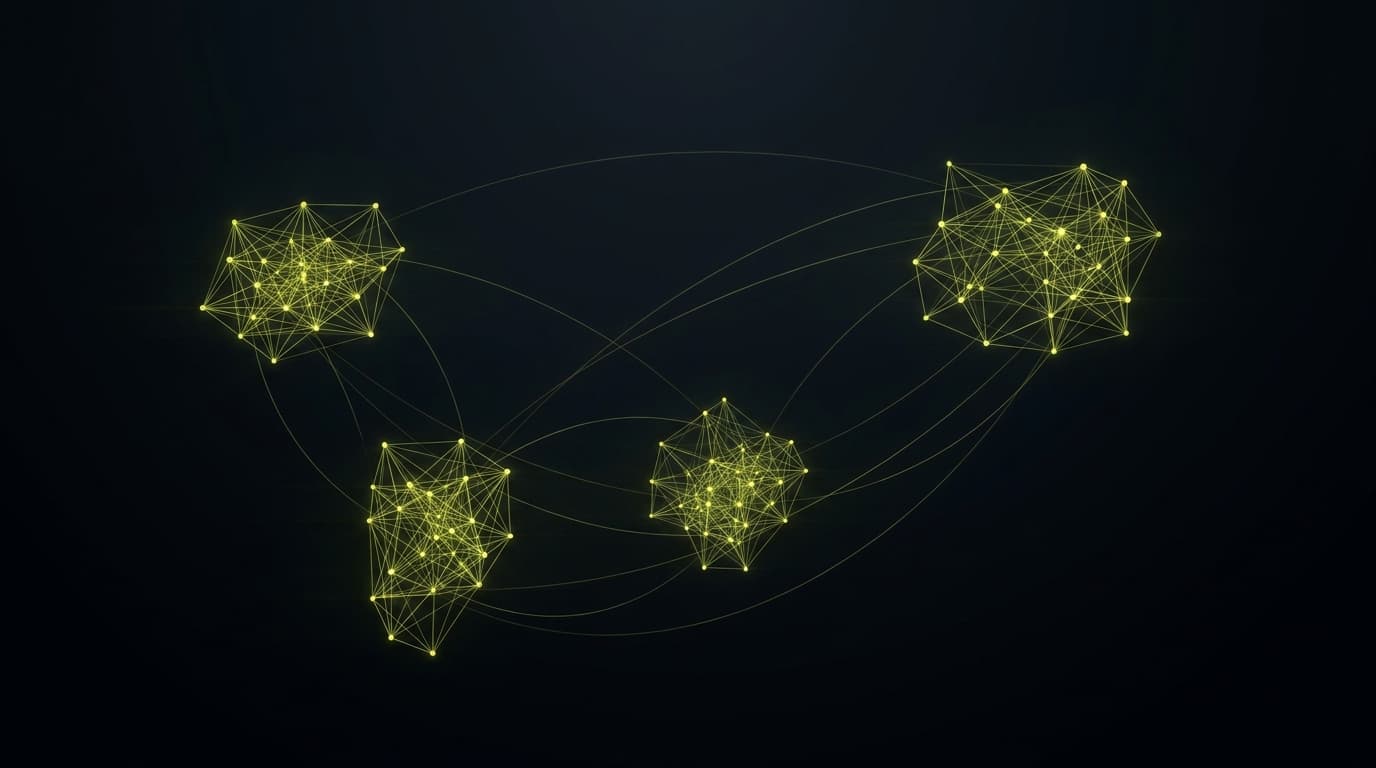
A deployed world model is the site's nervous system. Nodes form meshes on a site. Sites form clusters. Models, data and work move between them by content address — fetched once, reused everywhere. Each node holds the scope it's shaped for; it asks others when it needs more. Sensors, machines, and robots stop being isolated devices and start thinking as one body. The operator picks how local stays local and what crosses the line.
Meshes & clusters
How it composes
| Meshes | Nodes on one site form a peer fabric. They discover each other on the local network, then talk to each other directly — no central server in the middle. The operator picks the transport that suits the site. |
| Clusters | Many sites coordinate as one cluster. Each site keeps running on its own; the cluster layer is how they share what they choose to share — observations, model updates, work that one site can't absorb. |
| Discovery | Local discovery on the LAN — nodes find each other in milliseconds. Wider discovery joins the local view to peers reachable across the cluster, when the operator allows. |
| Models ask models | When a small model needs more — a deeper read, a wider check, a richer modality — it asks a neighbour or a higher-tier node. No node holds the whole picture. |
| Content-addressed data | Models and large artefacts move by hash. Once an artefact is on one node, every other node can pull it from there. The same content goes to many nodes, fetched once. |
| Brokered work | Work the local mesh can't absorb gets offered to the broader cluster, then — if the operator allows — to the wider network. Always priority-ordered: local first, then LAN, then off-edge, then refuse. |
Local first · LAN second · off-edge by grant · always fail-soft